



The appeal of a single-family office is real. Complete control. Full privacy. A team built entirely around the family's priorities. No shared infrastructure, no competing client relationships, no outside agenda.
What tends to get less airtime is the price tag.
Running a single-family office is expensive. Not in the abstract, "costs more than a private bank" sense. Expensive in specific, concrete ways that families often don't fully account for until they're in the middle of it. Understanding the cost structure before making the decision to build is not a detail. It's the decision.
Where the money goes
According to data from UBS and J.P. Morgan's 2024 family office reports, the cost categories are consistent regardless of jurisdiction or operating model. The proportions shift with scale. The categories don't.
Staffing. This is the largest line item in nearly every family office operating budget. The average single-family office employs around eleven people, according to J.P. Morgan, but half of all family offices operate with five or fewer. Compensation for experienced senior roles, a CIO or COO at the right level, ranges from $300,000 to over $1 million annually in many markets, before benefits, bonus, and the employer-side costs that come with a full-time employment structure. Add analysts, tax professionals, estate specialists, and administrative support, and the total staffing cost for a properly resourced office runs from $1.5 million to $4 million or more per year.
Investment operations. Families that manage assets internally need trading platforms, performance reporting tools, custodian relationships, and risk systems. For those using external managers, the costs shift to advisory fees, due diligence, and oversight infrastructure. Estimated range: $500,000 to $2 million annually, depending on scope and complexity.
Legal, tax, and estate. Whether in-house or through retained external counsel, these functions are ongoing, not one-time. Cross-border estate structures, complex tax filings, trust and entity management, and regulatory compliance all require attention that compounds as the structure grows. Estimated range: $250,000 to $1 million annually.
Technology and cybersecurity. Approximately a quarter of family offices have experienced a cybersecurity breach, according to industry surveys, yet many still operate without a formal cybersecurity programme. Secure communications, cloud infrastructure, portfolio reporting platforms, penetration testing, and vendor security assessments are not optional at the asset levels where single-family offices operate. Estimated range: $100,000 to $500,000 annually.
Operations and overhead. Rent, HR compliance, insurance, licensing, and the general cost of running an internal organization add a further $100,000 to $400,000 per year in most markets.
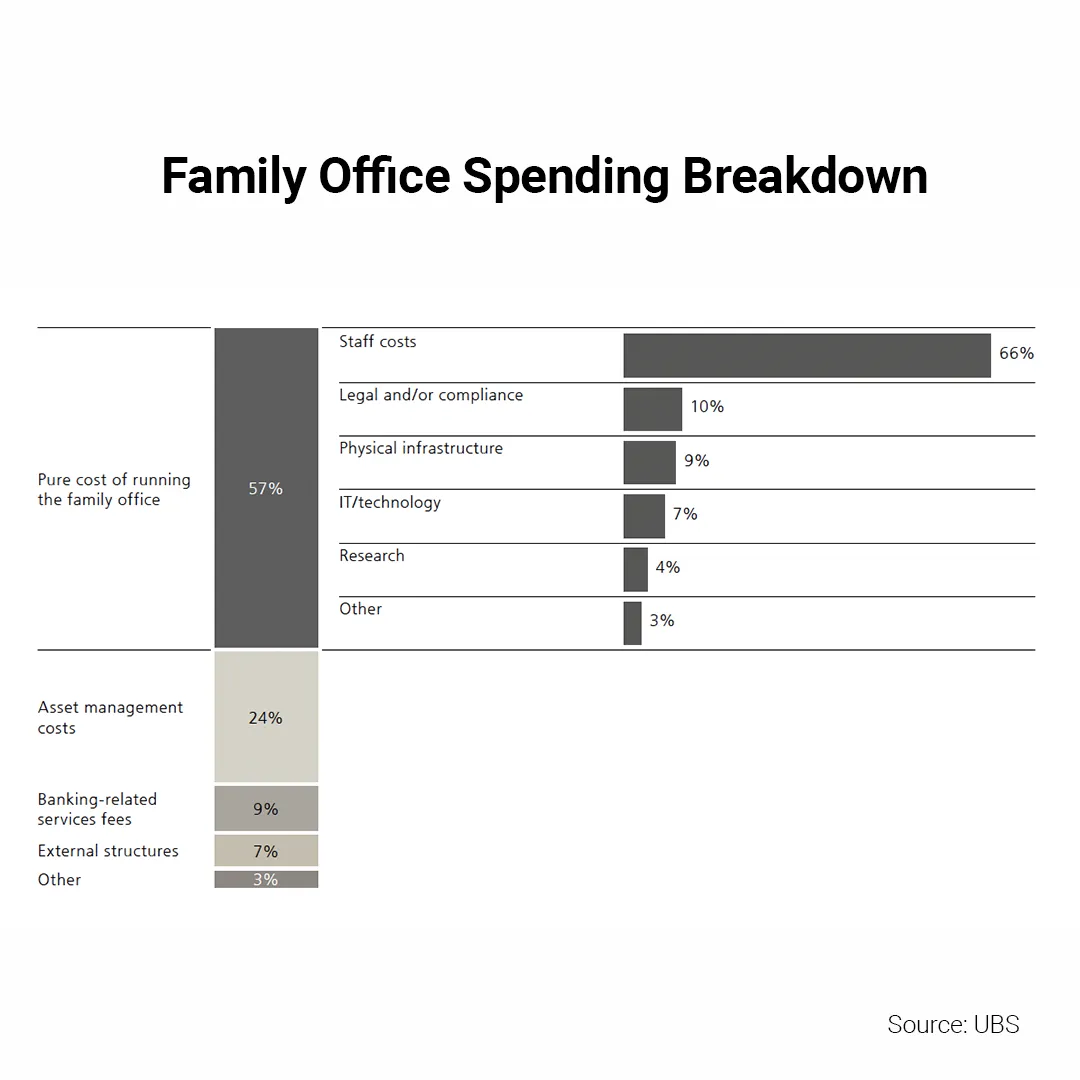
What the totals look like
J.P. Morgan's 2024 family office survey puts average total annual costs at around $1.5 million for offices in the $50M to $500M AUM range, rising to $2.7 million for offices managing $500M to $1 billion, and $6.1 million for offices above $1 billion. Top-quartile offices across all sizes spend $10 million or more per year.
These aren't outliers. They're what it actually costs to run a properly resourced operation with the staffing, technology, and compliance infrastructure that the structure demands.
Put another way: a family office with $50 million in assets spending $1.5 million annually is consuming 3% of AUM in overhead before a single investment decision is made. That's before taxes. Before any underperformance. Before lifestyle spending. The math is genuinely unfavorable at lower asset levels.
The threshold question
The data generally suggests that the single-family office model becomes economically rational somewhere above $500 million, and more comfortably rational above $1 billion. Below those levels, the overhead as a percentage of AUM becomes a meaningful drag on the overall outcome.
This isn't a hard rule. A family with $150 million in assets and exceptional complexity, multi-jurisdictional structure, active philanthropy, direct investment operations, and multi-generational governance, may well justify more internal infrastructure than the numbers alone suggest. Context matters.
But the default assumption that more wealth means more infrastructure is worth interrogating. The families who overbuild too early don't always realize the mistake until they've spent several years trying to manage an organization that's bigger than the work requires.
The alternative worth understanding
The data on traditional SFO costs is useful primarily because it clarifies what you're comparing against when you evaluate leaner models.
A well-designed lean family office with fractional specialists, professional technology infrastructure, and a small coordination layer can deliver comparable functionality in the $30M to $300M range for $150,000 to $300,000 per year. The difference in overhead runs from $1 million to several million annually, while the operational output, clear governance, consolidated reporting, coordinated advisors, and a functioning investment process, is largely the same.
The question isn't whether you want a family office. It's which model fits the actual complexity of your situation, not the complexity you're anticipating.
The decision to build a full single-family office is a real decision with real economic consequences. It should be made with accurate numbers, not assumptions inherited from the industry.
If you want an honest assessment of what structure fits your situation, the Wealth Clarity Session at Circle 26 produces exactly that. It looks at your actual complexity, scores it against your current governance infrastructure, and tells you what you need and what you don't.


Discussion