



It's the question everyone eventually asks, usually near the end of the conversation, usually a little carefully: how much does it cost to run a Lean Family Office?
There's no industry-standard fee for an office built this way — nobody surveys it, and there's no benchmark to measure yourself against. Meanwhile, the numbers that circulate publicly are enormous. J.P. Morgan's 2026 report put the average family office at around $3 million a year, and $6.6 million above a billion in assets. Anyone reading that and thinking "not for us" is drawing a reasonable conclusion from the wrong data.
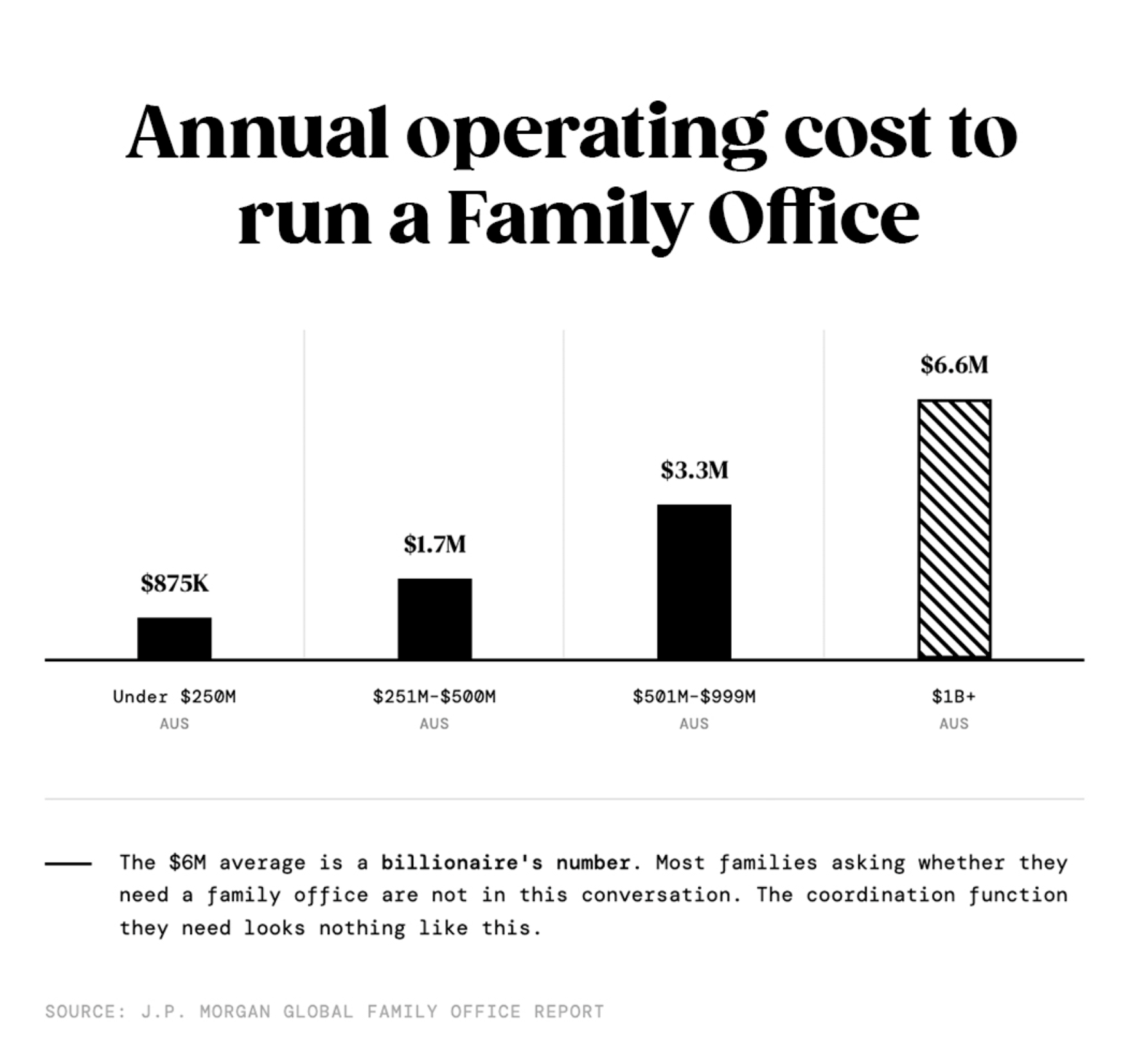
Two things get lost in the headline. The first is that the same survey found around 40% of family offices spending under a million a year. The average is being pulled up hard by the largest offices. The second is more useful: personnel is 60–70% of that cost. What families are really buying at those numbers is a payroll.
So I want to answer the cost question differently, because I can't give you a figure that means anything about your family, and neither can anyone else honestly. What I can do is give you the functions. If you know what has to exist, you can price it against the resources you already have, and most families discover they're already paying for some of it.
A Lean Family Office is built from four components. Every one of them has to exist. What differs, family to family, is how each is resourced.
1 · The governance layer. Decision rights, scope, cadences, escalation paths. Who decides what, up to what limit, and what happens when something exceeds it. This is mostly a build cost rather than a running cost, a defined piece of work that produces a documented result, then a light annual review to keep it current. It's also the component families most want to skip, and skipping it is what makes the other three expensive: capable professionals with no clarity about what the system requires of them.
This layer barely scales. Writing down who decides is roughly the same work for a family with $150 million as for one with $1.5 billion. Which means it's proportionally cheapest for exactly the families who assume they can't afford it.
2 · The digital backbone. One source of truth: the wealth map, the registers, the obligations, the record of what was decided and why. This is the component where the cost question is genuinely answerable, because the tools are priced and visible. There's a real range from properly structured spreadsheets and a document system, up to dedicated consolidation platforms. The honest answer is that the right choice depends on how many entities and asset types you're tracking, not on your net worth.
The build is the effort here, not the licence. Getting the picture accurate the first time is the work. Keeping it current afterward is a routine.
3 · The expert bench. Investment, tax, legal, compliance. Here's the thing most principals miss: you are almost certainly already paying for this. The bench isn't a new cost of building a lean office — it's the cost you already have. What changes is efficiency. Specialists working from prepared context, with the questions framed and the handoffs managed, spend less time reconstructing the situation and more time on the judgment you're actually paying for. Advisory hours spent on catch-up are the most expensive hours in your structure.
The cost driver here isn't assets. It's entities, jurisdictions, illiquid holdings, and transaction volume. Two families of identical wealth can be an order of magnitude apart on this line, and the reason is always structural complexity, never the number.
4 · The internal core. The coordination function. One person, sometimes two, who holds the full picture and owns the space between the domains that no specialist covers. This is the only component that cannot be outsourced, and it's therefore the one that determines the shape of everything else.
It's also the line where the real decision sits. Full-time, part-time, fractional, or the principal themselves. Most families are quietly running the fourth option without costing it, which is why the status quo always looks free.
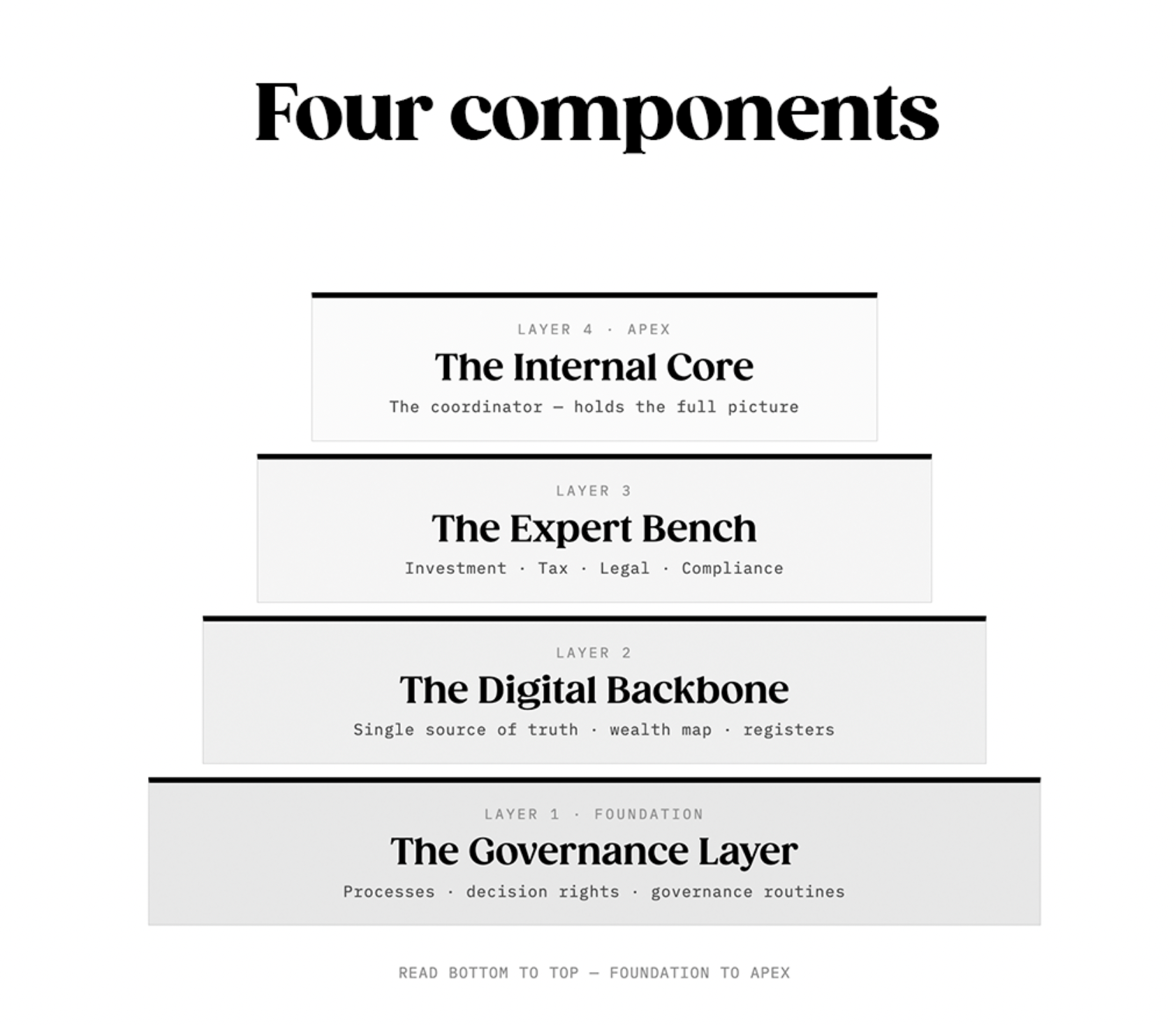
Four lines. Add up what you already spend against each of them and you'll have something more useful than any published average: the actual shape of your own cost base, and the gaps in it.
The pattern I see most often is that the bench line is already large, the backbone is underfunded, the governance layer doesn't exist, and the coordination is being done for free by someone whose time isn't in the budget. Which is not a spending problem. It's an allocation problem.
And that's the reframe I'd leave you with. Almost every principal I speak with asks what a Lean Family Office costs. Almost none has priced the one they're running now — the office made of memory, goodwill, and the assumption that the person holding it together will always be reachable. That system has no invoice, but it charges. The transaction that stalled while somebody hunted for entity documents. The insurance paid twice. The filing found late. The estate that took three years to untangle, not because it was contested, but because the only complete map was in the head of someone who was gone.
Compare against that, rather than against $3 million, and the question changes from "can we afford this" to "how much am I already paying, and what am I getting for it?


Discussion